That is, of course, unless you think about them the way I do, in which case bless you, friend, for not giving in to the unfortunate urge many fans of this great sport have to whip themselves into an uproar every time the Canadian Destroyer, a move popularized by Petey Williams 20 years ago and innovated before that by Quiet Storm and Amazing Red, doesn’t net a three count. God help wrestling Twitter if it’s merely a set-up or part of a combination, as it was last week during Kris Statlander’s defense of the TBS Championship against Britt Baker, who had the gall begin a sequence of other wrestlers’ finishers with it.
“I guess finishers mean nothing now” is a whole genre of wrestling “critique” that dates back to at least the first time a wrestler kicked out of a DDT on tape. The argument, if you want to think of this as an argument and not a successful ploy to garner engagement, is that finishing moves are not protected the way they ought to be, meaning that they don’t actually finish matches anymore and have been reduced to the level of the humble back suplex or bearhug.
Casting aside the obvious rejoinder, which is that those moves were once finishers themselves, I’d like to point out the following:
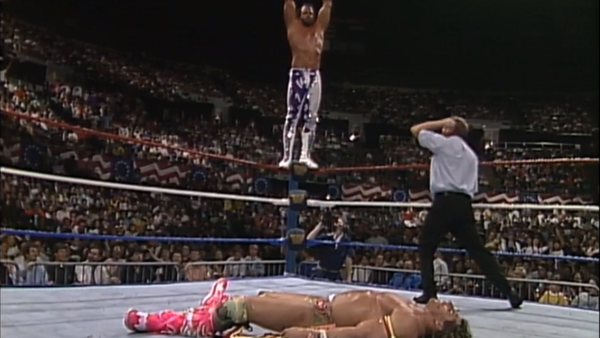
On March 24, 1991, the Ultimate Warrior kicked out of five straight “Macho Man” Randy Savage flying elbow drops. It’s one of the greatest matches of all time. It rules when a wrestler kicks out of their rival’s finishing move. Every time The Rock or Steve Austin kicked out of the Rock Bottom or the Stone Cold Stunner was basically a nail in WCW’s coffin.
Unlike the Ultimate Warrior, Kris Statlander did not kick out of Britt Baker’s finishing move. It would, indeed, be pretty difficult to kick out of Lockjaw, a submission maneuver that requires Baker’s opponent to be on their side, where they can’t be legally pinned.
This is pedantic, I know, but I spend a lot of time idly thinking about the narrative mechanics of pro wrestling, and the finisher is a trope that is intrinsically, inextricably tied to the form.
It’s your walk-off home run. Your sudden death goal or touchdown. Because wrestling is predetermined, those moves become symbols for the wrestlers themselves — Savage’s elbow, Hulk Hogan’s leg drop, John Cena’s Attitude Adjustment — and become romanticized (I don’t know what else to call the communal urge to photograph a singular, celebratory event) and made part of the tale, like in how Randy Orton’s RKO comes “outta nowhere” and the finishers of Kenny Omega and Kazuchika Okada are kicked out of on an exceptionally rare, count-them-on-one-hand basis.
But those moves work the way they do because they belong to the wrestlers performing them. This is also true of the Canadian Destroyer, Angel’s Wings, and curbstomp, none of which, again, are Britt Baker’s finishing maneuver.
“Still,” I can hear my strawman say, “these moves are special. They mean something.”
Well, yes and no. When all it takes to win a match is three seconds, every wrestling move means something.