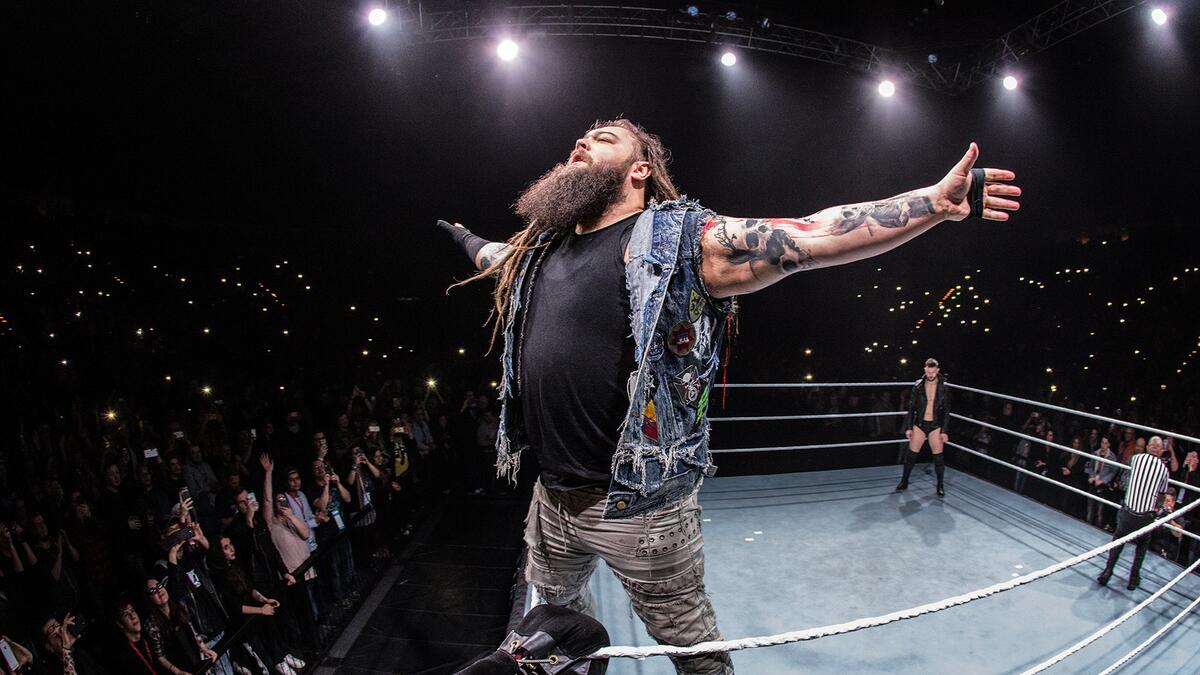
Yesterday, Windham Rotunda, known professionally as Bray Wyatt, passed away at age 36, the victim of a heart attack. According to Fightful’s Sean Ross Sapp, sharing information at the behest of Rotunda’s family, he was preparing to return to WWE following a bout of COVID, which exacerbated his heart issues, which leads us here.
The shock of Rotunda’s passing is massive. A day earlier, Terry Funk passed away. He was 79 years old, his legend so large it’s hard to believe one man was capable of a quarter of it, a life lived and realized in full. Something you could celebrate. Rotunda’s death is something else, something profoundly sad. He, too, has a legend, but he was 36. He had a prolific career, one that will be studied for years to come, but in this moment that feels extremely small. He had a wife. He had young children. There was a lot of road ahead of him and then, suddenly, there wasn’t.
I say that his career feels less important than the reality of his absence, but his career is how I engaged with him – stories about his character are for others to tell. I was frequently critical of Bray Wyatt’s whole deal, but more than anything that was due to potential I saw in him as an in-ring performer that manifested itself in flashes but often took a backseat to WWE’s inability to meet the way he approached wrestling, which was with a clear and obvious love for horror cinema, with their stilted approach to wrestling production. The closest they really got – and this is to say that they basically nailed it – was his Firefly Funhouse match against John Cena from WrestleMania 36.
When NXT was a game show, Husky Harris was my guy in season two. It was a contrarian pick, but in 2010 there weren’t a lot of thick brawlers on the WWE roster, and as a perpetual fat kid with body dysmorphia, I’ve always sympathized with thick brawlers because they are not treated kindly by WWE, historically. Windham Rotunda was a third generation wrestler and a member of one of the greatest wrestling families ever, carrying both names as his own, and they decided to call him “Husky.”
At the time, NXT was a hazing ritual disguised as a television show. But if you were a freak for the product, like I was back then, you might have picked up on the potential inherent to some of the less obvious obvious candidates for future success in WWE. His character work had yet to emerge, but there were interesting flashes of physicality to his game – a back senton that would later pick up a lot of velocity, what Jim Ross would term “bowling shoe ugly” collisions, a burgeoning understanding of how to use his mass, and so on. The finish of this match against Kaval, for instance, is quite clever, particularly the way he forces Kaval into the ringpost before bringing him back into the ring for his finish with a reverse suplex.
It is incredible that anybody who appeared on those early NXT seasons made it. The big, obvious story is that of Bryan Danielson, whom the show seemed designed to embarrass, but Rotunda’s resiliency was something else. He broke onto the main roster by joining an already moribund Nexus faction that was getting stomped by John Cena before unceremoniously splitting in two so that he, Michael McGillicutty, and David Otunga could serve as cannon fodder for CM Punk. His tenure on television lasted from October 2010 to January 2011.
When Randy Orton punted him in the head, sending him back to WWE’s FCW developmental territory, it was as ominous a portent for his future with the company as Shawn Michaels and Triple H stuffing the Spirit Squad in a box labeled “Destination: OVW.” Very few wrestlers left The Nexus with anything salvageable to build upon, and Husky Harris was not one of those lucky few who did.
Enter Bray Wyatt.
In the above early Wyatt promo from FCW (he’s seconded by NXT washout Eli Cottonwood), you can see the tenants of Dusty Rhodes’ famed promo class at work. He has the sketch of a character, and in 1:42, he leads you from his origins as an abused child who may or may not have killed his father in a boat fire to his attraction towards preaching to how he is going to use professional wrestling as his revenge on a world that attempted to discard him.
He would refine this character over time, but it’s all there. A lot of people have drawn parallels from this first iteration of Bray Wyatt to Dan Spivey’s late-career Waylon Mercy character, drawn from Robert De Niro’s portrayal of Max Cady in Martin Scorsese’s Cape Fear remake, but Spivey’s turn as Mercy came at the end of his career – he looked older and heavier than De Niro’s Cady, and, even looking past Spivey’s clear decline, it’s unlikely that the character would have ever truly reveled in the cruelty of its inspiration.
Wyatt is, in my opinion, a different animal altogether. For one thing, he has the edginess of youth to him. For another, what happened in FCW and the relaunched NXT seemed to happen beyond the supervision of Vince McMahon, so the menace is cranked up far beyond what was normal of the company from the start, even in characters like the Hannibal Lecter-inspired Mankind. When Wyatt sings “Time Is On My Side,” he is channeling Robert Mitchum in Night of the Hunter, a man who didn’t just want to kill you, but make your whole world burn.
Cottonwood was replaced with Luke Harper and Erick Rowan, the three man unit christened The Wyatt Family, and even with Rotunda suffering a torn pectoral muscle, they were not long for developmental.
Unfortunately, they debuted in a feud against Kane, but man, their first night on Raw was something else. Bray Wyatt was an unparalleled master of the pre-tape, and this one was gold, lit lantern, Harper and Rowan dim in its glow until Wyatt announces “We’re here” and blows the lantern out. That theme song (by Mark Crozer, touring member of The Jesus and Mary Chain). The way someone in the crowd screams as if witnessing a grand guignol. The rocking chair. The hat flip as he saunters over to a downed Kane. The fans chanting “Husky Harris” probably bragged about being at this show and knowing about Wyatt’s stardom all along, but boy does it feel like they have no idea what’s coming.
I’m not entirely convinced WWE did, either, as the Wyatts were positioned as spoilers and chaos agents, anarchists with no clear purpose or trajectory, whose issues were simultaneously purposeful but vague. This era of WWE is practically defined by The Wyatt Family’s feud against The Shield, but Wyatt didn’t win his first championship until 2016, during the second iteration of the stable.
This has less to do with Wyatt being a character who wasn’t motivated by titles than it did with the fact that Wyatt and whoever he was partnered with could, for the most part, be counted on to be a meaningful obstacle for other wrestlers, even when it would have made sense for the Wyatts to win, and even if the feud didn’t bear fruit. They are instrumental to The Shield’s rapid ascent, and Daniel Bryan’s loss to Wyatt at Royal Rumble 2014 had as much to do with the launch of the Yes Movement as Batista’s victory in the Rumble itself. The Wyatts were so popular that they could handle the indignities of Bray’s first John Cena feud and shoulder the burden of WWE’s attempt to cool Bryan off without diminishing themselves, but they weren’t even bridesmaids to everyone else’s bride – they were like Jake “The Snake” Roberts, not really invited to the wedding, but there anyway.
Within all of this, you have their feud against The Shield, which may be modern WWE’s peak in terms of in and out of the ring storytelling. The Shield were mercenaries with an opportunity to take three slots in an Elimination Chamber match, The Wyatts were feral animals who recognized in The Shield a trio of natural born enemies. “A childlike excitement is coming over me,” Wyatt said about the clash in a promo leading up to Elimination Chamber, and in a way that is true much less frequently than wrestling would have you believe, the notion that pride meant more to two warring parties than a championship or money felt right. Check out this staredown from an episode of Raw before their first match:
It is perfect, basically. The Shield rely on control, but they have none, called back to the ring by Wyatt having already hopped the barricade to leave. Bray is not long on oratory, lighting the lamp and blowing it out just as quickly, no tricks, just the promise of something as volatile as fire. The crowd pops for both teams climbing onto the apron. The Shield bites, the crowd bites, and the Wyatts powder. It’s simple and effective, and it is led by the swaggering menace of Bray Wyatt, who isn’t a coward, but a predator playing with his prey.
The matches are legendary and have been for nearly 10 years now, a high watermark for WWE’s main event style that invited you to imagine a future where all six men involved – Wyatt, Harper, Rowan, Seth Rollins, Roman Reigns, and Dean Ambrose – ruled the WWE in some way or another. It didn’t always work out that way – WWE tends to believe itself smarter than its audience, booking as convoluted a path to the top for these wrestlers as they could, even though there was still money in The Shield in 2014 and the Wyatts in 2015. WWE never understood factions, preferring to push individuals over teams even in the context of stables like The Corporation or The Authority.
It’s a shame, because Bray Wyatt truly shined as the captain of a team, directing Harper and Rowan while contributing to the riot himself. There’s never really been a faction like the Wyatts in WWE before or since their first run. They were decidedly southern, a true unit not unlike The Freebirds in how they had a clear leader but split their in-ring responsibilities so that that leader could lay back in the cut, plotting, until it was time for him to either get his ass kicked or rally the boys to victory. You paid to see the Wyatts vs. The Shield, but the marquee matchup within those matches, at least on paper, was Bray vs. Roman, Bray vs. Seth, and Bray vs. Dean.
This isn’t a slight on Harper or Rowan. It was just clear very early on that WWE had determined their ceiling, and The Shield were just beginning to define themselves as individuals against the most compelling individual to wrestle in a WWE ring in years, short of CM Punk. When Wyatt sings “He’s Got the Whole World In His Hands,” it’s not just a cute affectation – he is the binding agent of these matches, the figure towards which the others are pulled. Wyatt’s magnetism was so otherworldly that it’s possible he could have saved Roman Reigns’ 2016 title reign had he not gotten injured, and that’s after The Rock crushed Rowan at WrestleMania, with Bray at ringside.
The title of this essay refers to Bray Wyatt’s legacy, which many will be quick to sum up in moments like the above, or his matches against Daniel Bryan, or his run as The Fiend, or in the creative decisions that could have made his star burn brighter had his lot not been being put to use elevating others.
All of this is fair, frankly, but in to me one’s legacy in wrestling isn’t really determined by championship victories or great matches or killer feuds – it’s about how a wrestler’s body of work is interpolated by the generation (or generations) that follow; the rest is just capitalism.
In Windham Rotunda’s case, it’s the greatness that he and his peers sparked in 2014, at the apex of one of WWE’s most relevant periods, yes, but it’s also a lot of the stuff I didn’t like about his later work. This is not a slight: as Bray Wyatt, Rotunda never stopped searching, never stopped evolving. “Reinvention” is a cliché in wrestling, a word you could probably apply to the various phases of his career, but what I’d say he performed were resurrections: every time the company burned him to the ground, he managed to rise from the ashes.
And in all of that, you have the makings of a wrestler who will be talked about for a long time, by fans and peers and wrestlers who’ve yet to set foot in the ring who were in some way compelled by him in their youth. That isn’t praise, just fact. That he passed at an age when many wrestlers of his generation really begin to find themselves is tragic, but there will always be something of Bray Wyatt in American professional wrestling; a struck match, a lit lamp, a buzzard forever in the distance, beckoning others to follow.