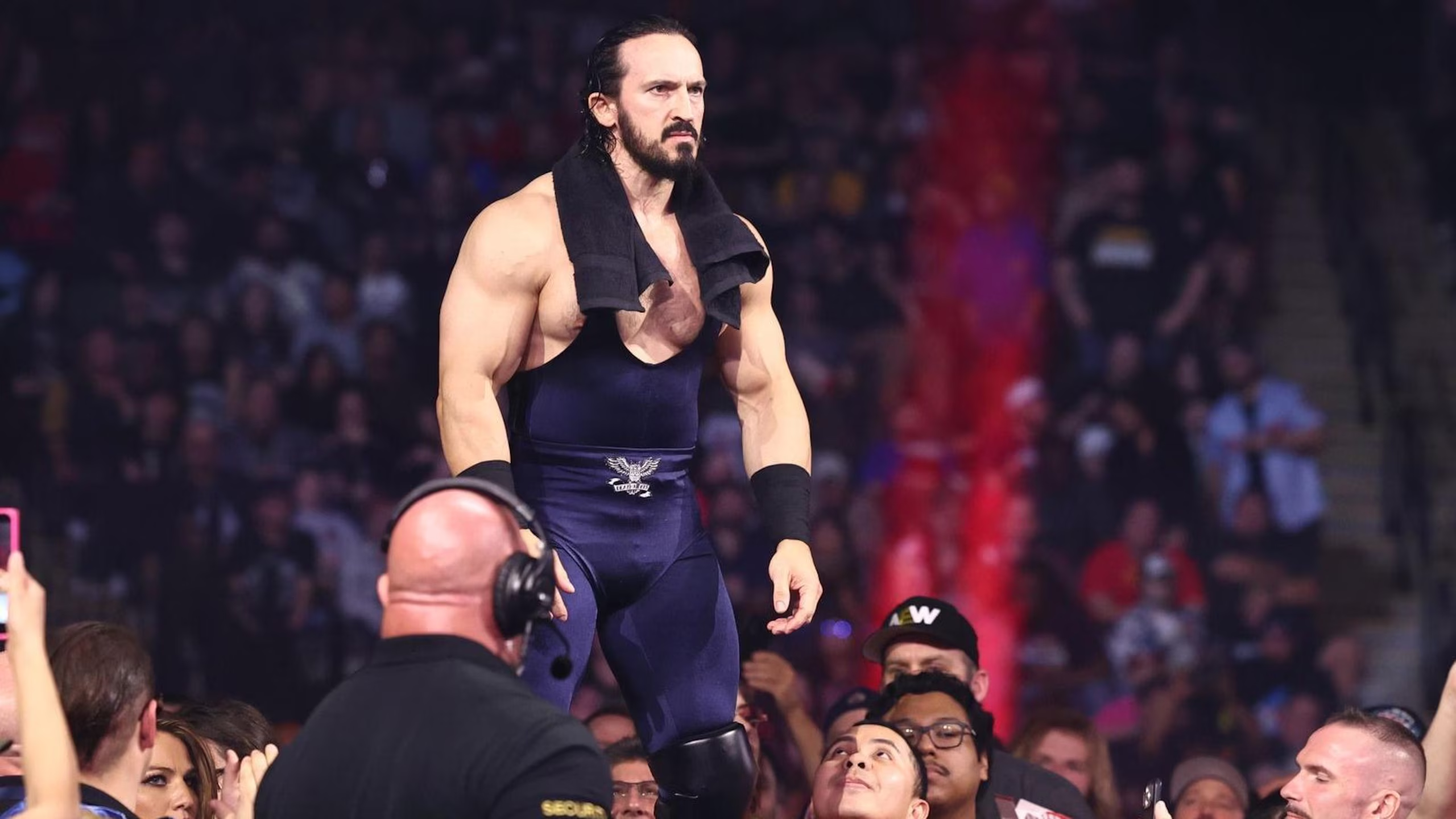
Last night, All Elite Wrestling announced the passing of Benjamin Satterley, better known as PAC and, during his WWE tenure, as Adrian Neville. He was 40 years old. A friend of mine texted me the news during a film screening I was hosting, but again, he was 40 years old, a high profile professional wrestler who had just wrestled Andrade El Idolo on Saturday night’s All Out pay per view, appearing later that night in the main event, so when my eye caught the word “PAC” when I briefly checked my phone during intermission, I assumed it was a text message about some spectacular spot I hadn’t yet had a chance to see. When the movie let out, I checked social media and saw a flood of remembrances for the man and for the wrestler, the all too familiar torrential outpouring of grief for a wrestler who is gone too soon.
Professional wrestling is not an easy way to make a living, and because its stakes are not real in the way the championships of other professional athletic competitions are, it is harder, I think, for people who don’t already love wrestling to view the risks associated with it as being worth the risk, especially when a wrestler dies young. I would wager that there isn’t a wrestling fan alive, regardless of their age or how long they’ve been watching, whose life has gone untouched by a tragedy like this. I started watching wrestling 34 years ago, as a child, and by the time I was in college had lived through the deaths of Brian Pillman, Louie Spicolli, Owen Hart, and Eddie Guerrero. The list of too-early deaths in the industry stretches back decades and marches forward into the future, a sad cycle of surprise death and prolonged mourning is unlikely to end unless wrestling ends. This is the grim, painful reality of wrestling fandom, but, in spite of that, I woke up this morning wanting not to let go of that fandom, but to take in as much of what Satterley produced as PAC and Neville as I could.
There is, to say the least, a lot of Benjamin Satterley work to engage with. He debuted in 2004 and, even accounting for injury time and a prolonged period where he sat out the remainder of his WWE contract, never missed a year. You can watch him in endless permutations: coming up in the British indies; his early US independent work with PWG, ROH, and CHIKARA; his breakthrough work in Dragongate; his work as the first real ace of WWE NXT; his struggle to define both himself and cruiserweight wrestling on the main roster; and as a sneering, domineering bruiser in AEW, at once central to the fledgling company’s identity and always a step or two removed from the world championship that his undeniable, once-in-a-generation talent seemed to demand.
That talent burned so brightly, was key to so many movements over the past two decades of professional wrestling, that there is something to recommend of his to suit every conceivable taste. He wasn’t just a great all-around wrestler, he was at or near the pinnacle of everything you could possibly want from the genre as a whole: a spectacular high flyer, a vicious striker, an unparalleled technician, a sympathetic babyface, a monster heel, an ace-in-the-hole enforcer, a presence that could carry a brand. He was all of this despite keeping an uncommonly modest profile — he wasn’t a wrestler you’d recognize in the airport, he doesn’t have years of press or in-depth interviews to build his case, but if you’ve saw him work, you knew he was one of the best wrestlers of his generation, if not the best, the mark he left upon the sport as singularly impressive as any of his more loudly acclaimed peers.
I didn’t know PAC, and that’s what endeared me to him: in an era of wrestling where everything in front of and behind the curtain is marketed for mass-consumption on social media, he was a wrestler first and foremost. On October 9, 2017, he walked out on his WWE contract, choosing to go home as opposed to soldiering on unhappily in a promotion that had marked him for superstardom in NXT before envisioning him, on its main roster, as a Mighty Mouse-style superhero and the face of the floundering WWE Cruiserweight division’s 205 Live, a show that was at once one of the best things WWE had ever produced and a kind of purgatory for its roster. Despite creating the concept of brand extensions and split rosters in an effort to better manage and promote its huge crew of wrestlers, modern WWE has always struggled to make more than one show matter at a time. 205 Live was cursed doubly, as it wasn’t just the fourth most important weekly show, it was also pinned to a weight division, a concept the promotion has never truly understood. This meant that if you weren’t watching 205 Live, you’d usually see its stars in one match on the PPV pre-show that aired for free on YouTube. Not only were they wrestling for a house that was filling in, the pre-show designation meant a lot to a wrestler’s bottom line: there was a difference between “WrestleMania” and “the WrestleMania pre-show” in terms of pay, both the night of the show and in terms of the royalties you might expect from DVD releases or WWE Network streams after the event.
Whether that’s why PAC left WWE or whether it was something else, like his being unhappy with his direction on the brand, we largely don’t know. There are reports from that time of discussions between him and WWE, some where he’d come close to agreeing to come back, others where they couldn’t be further apart, but he never spoke of them publicly, and, when he was granted his release in August 2018, he never did anything — a podcast, a shoot interview, or a jailbreak video for Twitter — to shed light on the subject. It was an incredibly brave thing for him to do, and once he secured his release he hit the ground running, not by signing to Impact Wrestling or doing a buzzy run of tours with ROH or NJPW, but by returning to Dragongate, a promotion he felt loyalty towards for taking him in so early in his career.
If he seems like a mercurial figure in all of this, I would say, again, that that mercuriality was to his benefit. On January 8, 2019, All Elite Wrestling held its first press conference, introducing the first members of its roster — a crew that would change the face of professional wrestling forever — and PAC was the unannounced surprise. Appearing in full gear where everyone else was in formal attire (hence the name of the annual AEW pay per view), he immediately cut a different figure than the rest of the inaugural AEW roster, his connection to any of them them buried far deeper in the collective past than All In or Wrestle Kingdom. For most American wrestling fans, who don’t have much interest in the British or Japanese independents, it was the first time he’d been seen since a five minute match against Ariya Divari on the September 26, 2017 episode of 205 Live.
A lot of ink has been spilled over the last seven years about the day one AEW roster, but PAC’s place in it, I think, has been undervalued. Before Cody Rhodes left AEW to return to WWE, before the trouble between CM Punk and The Elite, one of the derisive nicknames appended to the fledgling promotion was “All Friends Wrestling,” due to the perception that everyone there was connected in some way to Rhodes, the Young Bucks, or Kenny Omega. Before Jon Moxley’s debut at Double Or Nothing, before Chris Jericho lost the AEW Championship at an Outback Steakhouse, PAC was the wrestler who most flew in the face of that image, someone who’d cut his own path and had arrived in AEW not for its revolution, but for a fight. He was supposed to wrestle “Hangman” Adam Page at AEW’s inaugural show, but the match was called off for creative differences, which were patched up in time for him to make his AEW debut against Kenny Omega at All Out 2019 as a substitute for an injured Jon Moxley, a first-time-ever dream match that not only lived up to the premise, but set the standard for such things going forward, a foundational match in AEW history in terms of quality, creative vision, and the ability of its promoter and wrestlers to build and execute an arena-scale vision of professional wrestling well beyond the parameters established by WWE.
Whatever his differences with AEW were at the outset, his work was vital in defining it, and in legitimizing many wrestlers who didn’t have the same level of exposure as he did, or whose careers were in various states of repair. Kenny Omega was ostensibly AEW’s ace, but putting the title on him from day one was a risk — despite All In and the increasing popularity of NJPW and ROH, Omega hadn’t had many high profile singles matches in the United States, and his early feud against Moxley was a kind of iron-sharpening-iron situation as Moxley, a former WWE Champion, was still rehabbing his name after leaving that company. Throwing PAC into that mix accelerated things, and, despite the cancelled match at Double or Nothing, also helped bring Adam Page up to the level of his peers in The Elite, which his AEW Championship loss to Chris Jericho did not achieve. His trio with Penta El Zero Miedo and Rey Fénix, Death Triangle, seemed strange on its surface and stalled due to COVID-19 travel restrictions, but once PAC returned it clicked immediately, a vital counterbalance to The Elite and Best Friends.
The former rivalry is one that I suspect many will look back to as being definitional for AEW, if not for their role in establishing the AEW World Trios Championships, then for their role in reintegrating Omega and the Young Bucks into the fabric of AEW in the aftermath of All Out 2022. It’s their rivalry against Best Friends — specifically PAC’s against Orange Cassidy — that stands apart as quintessential AEW. Again, the company was young, with its fanbase and people working for the company projecting their ideas for what a WWE alternative should look like upon it, setting an impossible-to-reach standard that led to a lot of very frustrating conversations about how wrestling is like a variety show. Circumstances would later force AEW to truly cohere under the single vision of its owner/booker Tony Khan, but there was the Codyverse, the Eliteverse, the Jericho Vortex, and a dozen pocket universes contained entirely by one YouTube show or another, and with so many targets to swing a stick at, the one that got hit the most was comedy wrestling, particularly as practiced by Orange Cassidy.
If you were a fan of independent wrestling prior to the launch of AEW, an introduction to Cassidy’s ability was unnecessary, but if you were not, you might be as credulous about this slacker character with his hands semi-permanantly stuck in his pockets as a serious prospect for AEW’s future, but their match at Revolution 2020, Cassidy’s first singles match with the company, was a barnburner, an absolute starmaking performance on Cassidy’s part that was magnified by PAC’s uncanny ability to adapt to and magnify even the most idiosyncratic aspects of his opponent’s game. Cassidy became (and has remained) a stalwart workhorse wrestler for the promotion, a plug-and-play main eventer whose early run as the AEW International Champion still defines the title.
The match is a microcosm of what wrestling fans will remember PAC for, an almost singular ability to legitimize concepts and wrestlers that would have seemed far-fetched without his hand steering it in some form or fashion. Wrestling fans take many of them — The Death Riders, Cassidy, AEW, NXT — for granted in 2026, but he was there on the ground floor, laying the first bricks for multiple generations of professional wrestlers who followed. We took PAC for granted, too, but only because he was so young, because he seemed to be perpetually within striking range of the definitional victory that would have seen him finally climb to the peak of an industry he’d helped so many ascend. Like too many wrestlers before him, his career is a story whose finish will be left unauthored. It is up to his friends and his peers and his fans to pick up the pieces of what he leaves behind into the future of an art in which he stood as an unparalleled craftsman. The beauty of professional wrestling is that, in the aftermath of this sudden agony, many will. Benjamin Satterley will be missed, more than a mere fan can express. The Bastard will be with us forever.